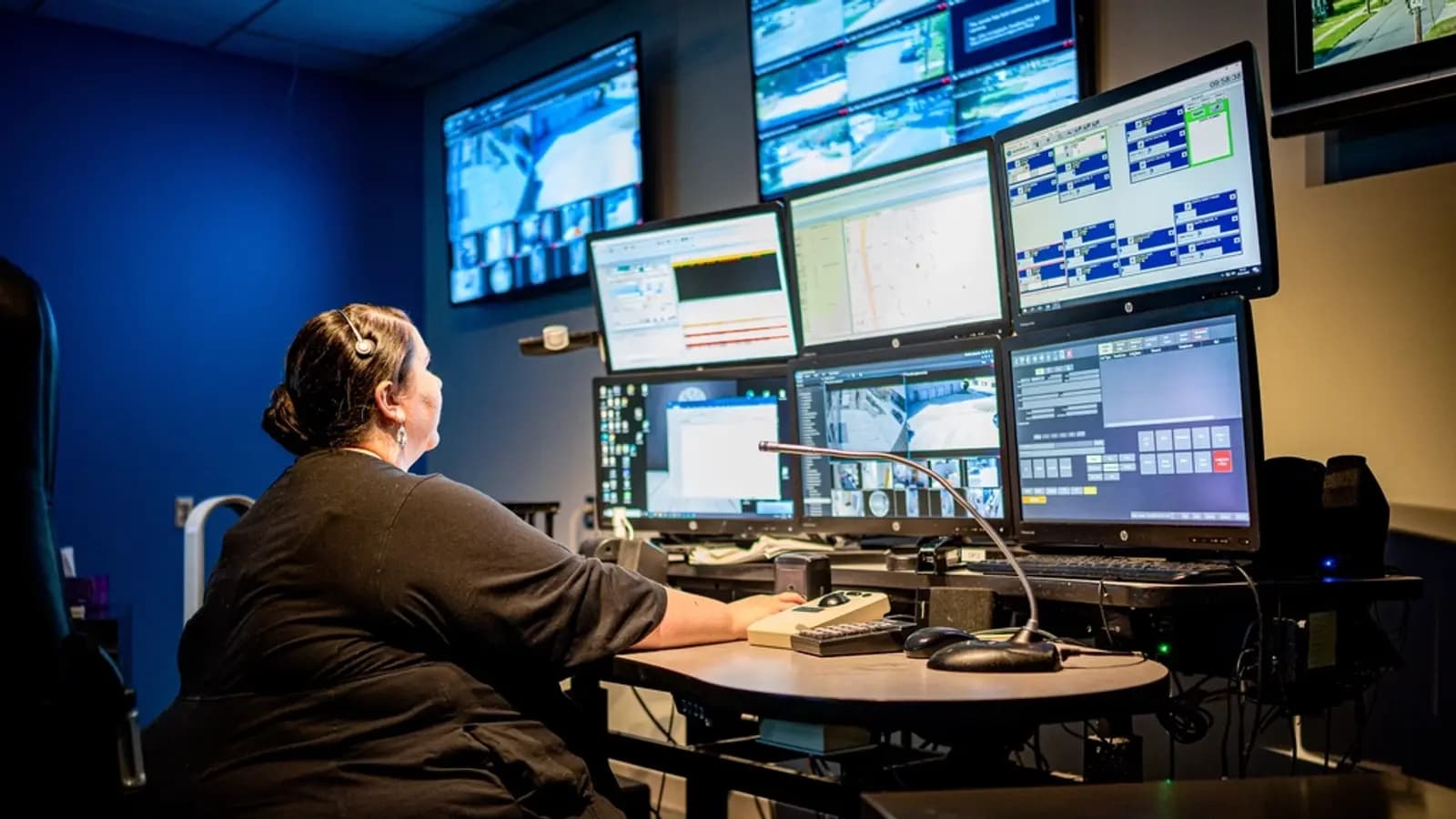
Two different products called an AI dialer
Search for an AI dialer and you get two different products under one name. One is a dialer that uses machine learning to decide when and whom to call. The other is a bot that talks to whoever answers. Neither is a predictive dialer, and on most floors the useful setup is a predictive dialer with a talking bot on top of it.
The first kind is a pacing engine with a new label. It looks at answer rates, agent availability and time of day, and adjusts how many lines it dials per agent. Some also score leads or pick the best hour to call a number. That is useful, but it is still a dialer. It decides when phones ring, and somebody still has to talk.
The second kind is a voice agent. It does not choose which number to call. It takes the connected call, talks, qualifies and transfers. Vendors call it an AI dialer because, from the buyer's side, it replaces the seat that used to sit in front of the dialer. When someone says they sell an AI dialer, ask which one they mean. The answer changes the contract, the migration and the price model.
What a predictive dialer actually does
A predictive dialer dials more numbers than you have free agents, on the bet that most will be voicemail, no answer or busy. It watches how long agents spend on calls and how often numbers connect, then sets a dial ratio so an agent comes free at roughly the moment a live person picks up. ViciDial and Convoso both do this, as do most floor dialers. The predictive dialing glossary entry has the short version.
ViciDial calls this the dial level, and in its adaptive modes it moves the level up and down on its own as conditions change. Convoso and most commercial dialers have their own version of the same idea. Either way, the dialer is reacting to how your agents behave, which is exactly why bots change the picture, as covered below.
The cost of that bet is the abandoned call: a person answers and no agent is free. US telemarketing rules limit how many of those you can have, and say what must happen when one occurs. That makes your dialer's pacing settings compliance settings, not just speed settings, so check them with your compliance team. If you are still choosing a dialing mode, our comparison of auto, predictive, power and progressive dialers goes through each one.
AI dialer vs predictive dialer, line by line
Here are the two side by side, using "AI dialer" in the sense most call center buyers mean it: a bot that holds the conversation.
- Job. Predictive dialer: decides when to dial and connects calls to free agents. Talking AI dialer: holds the conversation once the call connects.
- What it replaces. Predictive dialer: manual or preview dialing. Talking AI dialer: the fronter or verifier seat.
- What it owns. Predictive dialer: lists, hopper, caller ID, calling hours, recycling and dial ratio. Talking AI dialer: script, disclosure, qualification, transfer and disposition.
- How it fails. Predictive dialer: abandoned calls when it overdials, idle agents when it underdials. Talking AI dialer: AMD misfires, misheard answers, awkward replies.
- How it is usually priced. Predictive dialer: seat licenses or a platform fee, plus telephony. Talking AI dialer: per minute or per bot, depending on the vendor.
- Do you need it? Predictive dialer: yes, if you run volume. Talking AI dialer: only if fronting or verification is the bottleneck.
How a talking bot sits on top of the dialer
The cleanest setup treats each bot as an agent. The bot logs into the dialer, the dialer connects a call to it as it would to a fronter, and the bot hands qualified callers to the closer queue. The dialer keeps the list, the caller ID and the pacing. The bot keeps the conversation and writes the disposition back.
That split is why nothing has to be migrated. Our dialer integration is deliberately small: take the next call, talk, transfer, write the disposition. Telephony stays on your carrier, and your numbers keep the reputation you built on them.
It also keeps responsibility clear. If a number should never have been dialed, that is a list and dialer question. If the call went badly once connected, that is a bot and script question. Floors that blur the two spend a lot of time blaming the wrong vendor.
One overlap to settle early is answering-machine detection. Many dialers have their own AMD, and a talking bot may have its own as well. Running both can mean the dialer drops a call the bot would have handled, or the reverse. Decide which one makes the call on bot campaigns, switch the other off for those campaigns, and compare voicemail and hang-up numbers for a week.
Does pacing change when bots are the agents?
Yes, and this is where floors get surprised. A predictive ratio is tuned around people: breaks, wrap-up time, somebody stepping away for tea. Bots take no breaks and wrap up instantly, so the dialer sees an agent who is always ready. Some floors find they can run a lower ratio and still keep every bot busy, which also tends to mean fewer abandoned calls.
Capacity becomes simple arithmetic too. With our bots, one bot holds one concurrent line, so twenty bots means twenty conversations at once. There is more on how bot concurrency works if you are sizing an order. You scale by adding bots, not by pushing the dial ratio and hoping the abandon rate holds.
What does not change is the closer queue. Add bots and keep the same closers, and transfers stack up waiting. Plan both sides of the transfer together.
Verifier bots fit the same way, one step later. The closer finishes the sale and transfers the caller to a verifier bot logged into the same dialer, which confirms the details on a recorded line and writes them back. The dialer does not need to know that one agent is a bot and another is a person. It just routes calls.
Do you need to replace your dialer to use AI?
Usually not. If your ViciDial or Convoso setup works, keep it. Replace a dialer when the dialer is the problem: it cannot pace properly, it does not support the compliance settings you need, or you want one vendor for everything. Platforms such as Convoso include their own virtual agent, and for a floor consolidating vendors that is a fair choice. Our Convoso comparison sets out when that path makes more sense than adding bots to what you have.
Migration has a cost that rarely appears on a vendor's slide: retraining managers, rebuilding reports, moving lists and recordings, re-registering numbers and running two systems while you switch. If the only reason to move is to get a talking bot, that cost is usually bigger than the benefit. Add the bot to the dialer you have, and judge the dialer on its own merits, on its own timeline.
Questions to ask anyone selling an AI dialer
Take these into the sales call. A vendor who cannot answer them plainly is selling you a demo, not a product.
Write the answers down and compare vendors side by side. The price question in particular only becomes comparable once every vendor has given you a cost for the same shift length and the same number of lines.
- Is this a dialer, a bot, or both? What exactly do I stop using?
- Do I keep my carrier, my caller ID and my lists?
- Who sets the dial ratio, and how are abandoned calls handled?
- How does the bot receive calls: an agent login, a SIP route or an API?
- Are dispositions written back into my dialer using my own codes?
- What happens to a qualified caller when no closer is free?
- Is it priced per seat, per minute or per bot, and what does a full night shift cost me?
- Can I pilot it on a slice of one list without moving anything else?
Where B3 Voice sits
B3 Voice is not a dialer. We sell fronter and verifier bots that run on the dialer you already have, take the calls it connects and write dispositions back into it. If that is the shape you need, the ViciDial integration page shows how the bots log in and what stays untouched.